
Online, a “decorative stone-effect panel” can mean anything from a €30 polystyrene product to a hand-painted mineral resin panel costing over €100. On the wall, the result is worlds apart. This article compares the different solutions on the market, what really sets them apart, and why the material matters just as much as the design.
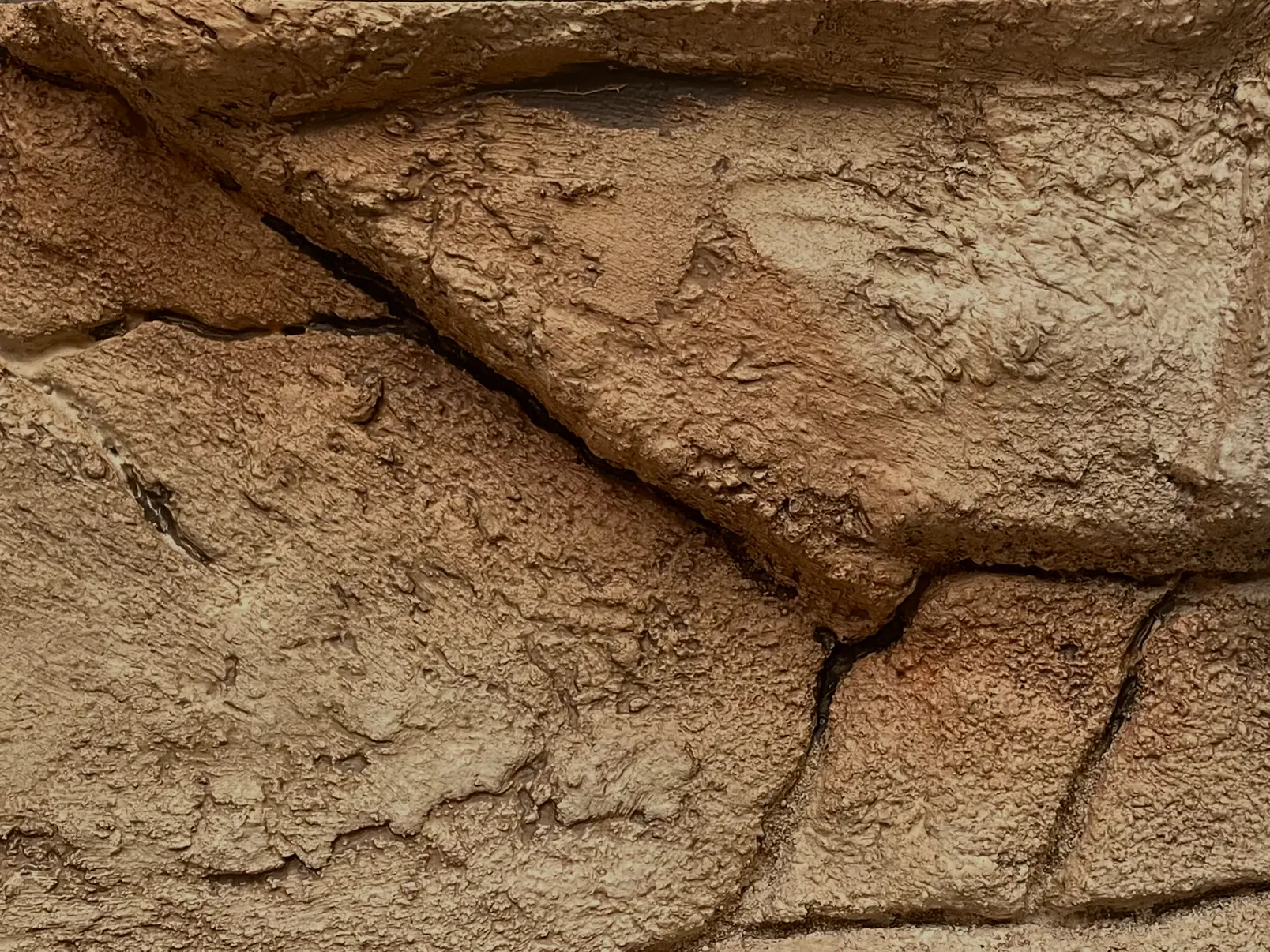
The Óros panel: a mineral resin panel, first and foremost
Petralithe’s Óros panel is, first and foremost, a mineral resin panel. Mineral resin is a dense, hard composite loaded with minerals, and it makes up the entire visible surface of the panel. It’s what you see and touch, and it’s what gives the product its strength, its deep relief and its texture, so close to natural rock.
So why do people sometimes talk about “foam”? Because the panel’s inner core is made of high-density foam, a technical choice that brings several advantages. First, its density makes the panel rigid and strong while keeping it very lightweight. Second, it provides acoustic and thermal insulation. But the foam is neither the material you see nor what determines the quality of the product.
The surface material of a decorative panel determines everything: the depth of the relief, the realism of the textures, impact resistance, long-term durability and the quality of the finish. An expanded polystyrene panel and a mineral resin panel have nothing in common but their purpose. On the wall, the result is completely different.
What is an Óros panel made of?
To understand what sets an Óros panel apart from a standard product, you have to look at what’s inside. Each panel is made up of several layers, each with a specific role.
Structure of an Óros panel — from the outside in
1 - Hand-painted finish
Each panel is individually coloured and shaded by hand in our Issoire workshop. This craftsmanship creates realistic variations in tone that no industrial process can replicate. It’s this layer that gives each panel its unique character.
2 - Mineral resin surface
This is the key material. Mineral resin is a dense, hard composite loaded with minerals, which makes it possible to mould deep, detailed reliefs. It gives the panel its surface strength, its impact resistance and a texture that feels close to real stone.
3 - Rigid foam core
La mousse rigide constitue le corps du panneau. Cette mousse haute densité remplit plusieurs fonctions. Elle allège le panneau : sans elle, un panneau de cette surface serait trop lourd pour une pose par simple collage. Sa densité garantit aussi un panneau rigide et solide. Enfin, elle apporte une isolation phonique et thermique. La mousse est un choix technique, pas le matériau « noble » du produit.
4 - Interlocking puzzle system
Les quatre côtés de chaque panneau sont découpés en forme de puzzle pour un assemblage bord à bord sans joints visibles. Les raccords disparaissent une fois le mur terminé, créant l'illusion d'une paroi rocheuse continue.
It’s this combination of a mineral resin surface and a rigid foam core that makes the product both realistic to the touch and light to install.
Comparison: market solutions head to head
The stone-effect wall cladding market covers products made from very different materials, from manufactured panels to natural stone veneers. Here is an objective comparison of the main types of solutions.
1. Expanded polystyrene (EPS)
These are the cheapest panels on the market, often sold in bulk on online marketplaces. The surface is moulded directly in polystyrene, an ultra-lightweight but fragile material. The relief is shallow (just a few millimetres), the texture lacks detail, and the material scratches at the slightest friction. A fingernail is enough to mark it. The result can pass from a distance in a secondary room, but doesn’t stand up to a closer look. These panels are usually white and must be painted after installation.
2. Rigid PVC
A step up from polystyrene, PVC panels offer better resistance to moisture and light impacts. However, they remain thin (2 to 3 mm) and have almost no relief: it’s more of a printed image on the surface than a true texture. The “plastic” look is noticeable to the touch and under grazing light. These panels are better suited to practical applications (kitchen splashbacks, showers) than decorative ones.
3. High-density polyurethane (PU)
This is the dominant solution on the international market, used by most of the major brands. Polyurethane allows deeper relief than PVC and better impact resistance. The colour is integrated into the material during moulding. The result is convincing from a distance (beyond 1.5 metres), but the tones remain uniform: the natural colour variations of stone are difficult to reproduce with this industrial process. By nature, the material is still an expanded plastic.
4. Polyester and fibreglass
Used by industrial manufacturers, this technology combines polyester resin with a fibreglass reinforcement. The panels are thin (a few millimetres), lightweight and water-resistant. Some brands achieve decent visual results thanks to mineral pigments printed into the material. The relief, however, is fairly flat: what you gain in strength, you lose in texture depth.
5. Natural stone veneer sheets
These are genuine thin slices of stone (slate, mica) bonded to a fibreglass and resin backing. The look is authentic, since the material really is stone, with all its natural variations. However, they are very thin (2-3 mm), have almost no relief, and the product looks more like a surface covering than a rock wall. The fragility of the sheet also requires care during installation.
6. Natural stone wall cladding
Natural stone cladding consists of genuine stone tiles (limestone, quartzite, slate, travertine) 1 to 3 cm thick, either bonded or mechanically fixed to the wall. In terms of material, it’s the most authentic solution: the stone is real, with its veining, imperfections and density. There is some relief, but it comes from the split face of the stone, without the depth of a sculpted rock face. The main drawback is weight: between 30 and 70 kg/m² depending on thickness and stone type, which requires a solid load-bearing structure and professional installation. The cost is also significantly higher, both for the material and for the labour.
7. Mineral resin (Petralithe technology)
Mineral resin is a mineral-filled composite that combines the hardness of stone with the lightness of a manufactured panel. It allows reliefs several centimetres deep: our panels feature reliefs ranging from 1 cm to 8.5 cm. The surface is hard, impact-resistant and feels close to stone to the touch. Combined with hand-applied paint, it delivers realistic variations in tone and a unique finish on every panel.